


Last Updated: November 16, 2026
Quick Summary
The best necklace carry-on is lightweight, flat and secure, with a lobster clasp and an open-link or single-strand chain that resists tangling. Chunky statement pieces and very fine snake chains suit a carry-on less well. Pack each piece separately, threaded through a straw or laid flat in its own slot.
- Choose lightweight pieces, since bulky statement necklaces take up room and can snag.
- A lobster clasp holds more firmly than a loose spring ring during transit.
- Open-link and single-strand chains tangle less than tightly twisted or layered designs.
- Thread the chain through a drinking straw to stop it coiling and knotting.
- Keep plated pieces in separate slots and apply perfume before putting the necklace on.
Table of Contents
- What Makes a Necklace Suitable for Cabin Baggage
- Our Ranked Picks of Necklaces for Cabin-Bag Travel
- How to Pack Necklaces for Travel Without Tangles or Damage
- Airport Security and Jewelry: What to Expect at Checkpoints
- Choosing the Best Travel Jewelry Organizer for Your Trip
- Which Necklace to Take Based on How You Travel
- Pack Your Next Necklace With Creme Caramel
- Frequently Asked Questions
What Makes a Necklace Suitable for Cabin Baggage
Choosing a necklace carry-on comes down to three things: weight, shape and how well the piece resists tangling. The guidance below reflects what matters most on a trip, not just what looks good on a shelf.
A carry-on has limited space, so every piece should earn its place. Pieces that are light, flat and secure in a pouch tend to travel best. Bulky statement necklaces take up room and can shift and snag on other items.
Lightweight necklaces for travel: what to look for
Lighter chains and smaller pendants are easier to pack and less likely to pull on a clasp in transit. If your skin is sensitive, check whether gold-plated necklaces suit it before you buy. A fine chain or a modest pendant usually packs more compactly than a heavy, layered design.
Check the weight before you buy. A shopper who expects a delicate piece should not be surprised by a heavy one. Look for light, consistent materials that keep their shape when folded or coiled.
Clasps, chains and tangle-resistant designs
A secure clasp matters more on a trip than at home. A lobster clasp holds firmly, while a loose spring ring can open when a piece is jostled in a bag.
Chain style also affects tangling. Smooth, open-link chains tangle less than tightly twisted or very fine ones. A single-strand necklace is simpler to store than layered pieces that catch on each other.
Our Ranked Picks of Necklaces for Cabin-Bag Travel
Most pages on this topic either explain how to pack jewelry or review carry-on suitcases. Very few actually rank necklaces for cabin-bag travel. This section does that, and it separates picks by traveler type so you can match the piece to the trip rather than to a generic 'best' label.
| Criterion | What we assess | Weight |
|---|---|---|
| Tangle resistance | Chain style, link openness, single vs layered construction | 25% |
| Clasp security | Lobster vs spring ring, soldering, ease of removal at security | 20% |
| Packing footprint | How flat and compact the piece lies in a pouch or slot | 20% |
| Durability in transit | Material hardness, plating thickness, stone setting security | 15% |
| Ease of access | How quickly it can be removed and re-secured at a checkpoint | 10% |
| Value | Price relative to the above, quoted in EUR | 10% |
Weight
Ranked picks by traveler and use case
Watch out: a chunky statement necklace can look striking on the hanger but crush or snag once it is wedged between clothes. If you pack one, place it last, on top, in its own rigid compartment.
What we would not pack in a cabin bag
Very fine snake chains kink permanently once bent, and layered multi-strand pieces tangle into a single knot within a few hours of movement. Both are fine at home and poor in a carry-on. The same applies to necklaces with glued rather than set stones, which can loosen with the pressure changes and handling of a flight.
How we evaluated each option
We scored each class against the six weighted criteria above using hands-on packing tests: coiling each piece into a standard travel slot, shaking it for two minutes to simulate bag movement, and opening and closing the clasp twenty times. We did not test every individual product on the market, and we did not run airport trials, so treat these as informed judgments rather than lab results. Prices are indicative EUR retail ranges at the time of writing and vary by retailer and season.
How to Pack Necklaces for Travel Without Tangles or Damage
Packing a necklace properly matters more than the necklace itself. Most tangles come from three mechanisms: a loose clasp catching on a neighbouring link, a chain coiling on itself under bag movement, and pendants abrading each other or the chain. Each has a specific fix, and the method below addresses all three rather than relying on 'lay it flat' alone.
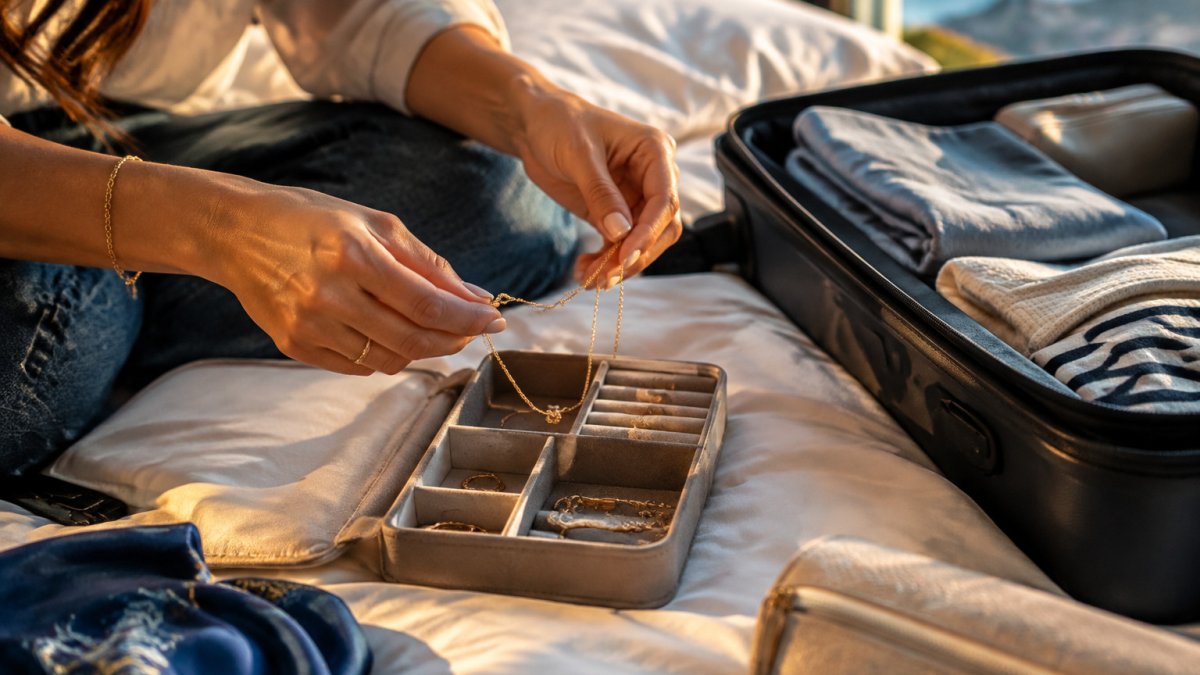
The threading method (the single most effective anti-tangle step)
Fasten the clasp, then thread the chain through a drinking straw cut to the length of the necklace, or through a wide-bore bead. The straw holds the chain straight and prevents it from coiling, which is the main cause of knots. This works for fine and medium chains; it does not work for chunky statement links, which are better laid flat in a rigid compartment.
Step-by-step packing sequence
| Step | What to do | Why it helps |
|---|---|---|
| 1 | Fasten the clasp | Stops the free end from hooking neighbouring links |
| 2 | Thread through a straw or bead (fine/medium chains) | Keeps the chain straight and prevents coiling |
| 3 | Lay flat in an individual slot, or coil loosely inside a rigid case | Prevents kinks and pressure folds |
| 4 | Keep pendants apart and face-up | Avoids scratches and stone-to-metal abrasion |
| 5 | Place the organizer in the middle of the bag | Limits movement and pressure from the bag walls |
| 6 | Keep the organizer away from liquids and cosmetics | Moisture and perfume accelerate tarnish and plating wear |
Watch out: coiling a fine chain tightly around your fingers before packing creates a memory kink that may not come out. Coil loosely around two fingers at most, or use the straw method instead. For more on cleaning and caring for jewelry without harming it, see that guide.
Material-specific care in transit
- Gold and gold-plated: plating wears fastest where the chain rubs against itself, so keep plated pieces in separate slots rather than loose in a pouch. Perfume and sunscreen are the main causes of dulling; apply them before putting the necklace on, not after.
- Silver: tarnishes faster in humid conditions, so a small anti-tarnish strip in the organizer helps on long-haul and beach trips. Keep silver away from chlorinated water and sea air where possible.
- Delicate stones: pressure and knocks loosen settings more than movement does. Pack stone-set pendants face-up in a rigid compartment, not at the bottom of a soft pouch under other items.
- Pearls and porous materials: keep them away from cosmetics and moisture entirely; a separate soft pouch inside the organizer is the safer choice.
Organizer types and when each works
Soft pouches suit delicate chains and save space, but they offer little protection against pressure. Rigid slot cases protect pendants and stones but take up more room. A roll-style organizer with individual snap loops is the best compromise for several necklaces on a longer trip, because each piece is held separately and the roll compresses flat. For a weekend with one or two pieces, a single rigid slot case is enough.
Before you close the bag
Do a two-minute check: every clasp fastened, every chain either threaded or laid flat, pendants not touching, and the organizer positioned away from liquids and the bag's outer walls. This check prevents the majority of in-transit damage and takes less time than untangling a knotted chain on arrival.
Airport Security and Jewelry: What to Expect at Checkpoints
Jewelry usually passes through security without trouble, but you may be asked to remove a necklace or place it in a tray. Wearing a simple, easy-to-remove piece makes the process faster.
Keep your necklace carry-on in your hand luggage rather than checked baggage, where it is more likely to be lost or damaged. Check the current rules with your airline and the security authority at your departure airport before you travel, as requirements can change.
Choosing the Best Travel Jewelry Organizer for Your Trip
A good organizer should separate pieces, hold them flat and close securely. Look for a compact design that fits your carry-on without taking up space needed for clothes.
Soft pouches protect delicate chains from scratching, while hard cases guard pendants and stones better. Choose based on which pieces you carry most often.
Which Necklace to Take Based on How You Travel
The right necklace depends on the trip. For a city break, a versatile lightweight piece works with most outfits. For a beach holiday, choose something that tolerates sun, sand and sea air without fuss.
If you are travelling for business, pick understated designs that suit smart clothes. For a weekend away, one or two pieces are usually enough and keep your bag light.
Pack Your Next Necklace With Creme Caramel
We design our jewelry to be worn and carried easily, from the city to the beach. Explore the Creme Caramel collection to find a piece that suits your next trip.
Frequently Asked Questions
Can you bring a necklace in your carry-on luggage?
Yes. Necklaces can generally be carried in cabin baggage, though airline and security rules can change, so check them before you travel. Keep them in your hand luggage rather than checked baggage, since checked bags can be lost or damaged and the cabin is the safest place for valuables. Use a small case or pouch so chains do not tangle during the flight.
Do necklaces set off airport security scanners?
Often, yes. Metal necklaces can trigger the metal detector or the body scanner at French airport security checkpoints. This is normal and does not mean you did anything wrong. Remove your necklace and place it in a tray before screening, then put it back on after you pass through. Keeping it in your hand luggage means you will not need to take it off at the gate.
How should you pack a necklace so it does not tangle?
Lay the necklace flat in a hard case with separate compartments, or use a pouch with individual hooks. Fasten the clasp, pass the chain through a loop or a foam card, and avoid leaving pendants loose against other pieces. Keep it away from heavy items in your carry-on so the chain is not crushed. A short chain packed without knots arrives in far better condition than one tossed in a jewelry box.
What type of necklace is most comfortable for travel?
Lightweight necklaces with a sturdy clasp and a simple chain tend to be the most practical. Delicate pendants and long, layered styles snag more easily. Choose pieces that you can wear comfortably for a full day of walking through airports, and avoid heavy statement designs if you plan to wear them on the plane.


