


Table of Contents
- Comprendre la douleur de cicatrice de césarienne
- Caesarean scar healing time : les étapes de la guérison
- Caesarean scar tightness and sensitivity : gérer tiraillements et sensibilité
- Caesarean scar massage after birth : quand et comment masser en douceur
- Soulager la douleur au quotidien : mouvements et adaptations
- Warning signs of caesarean wound infection : reconnaître les signaux d'alerte
- Douleur persistante : que faire si la cicatrice fait encore mal après des mois
- Conclusion
- Frequently Asked Questions
Last Updated: October 17, 2026
Comprendre la douleur de cicatrice de césarienne
A cicatrice de césarienne is a surgical scar that forms after a caesarean birth, and the pain you feel around it is a normal part of postpartum recovery. This guide covers how to relieve that pain safely, day by day.
Here is the part most guides get wrong: a caesarean scar is not just skin. It runs through skin, fat, muscle and connective tissue. That is why the pulling, the tenderness and the odd numbness can last far longer than the visible line.
Many women find the first weeks the hardest. A common mistake is to treat the scar as fragile and avoid all movement. In practice, gentle, staged activity helps soft tissue heal better than total rest.
Below, we walk through what each stage feels like, what you can do yourself, and when to call a midwife or doctor.
Caesarean scar healing time : les étapes de la guérison
Caesarean scar healing time usually runs in three stages: the first 6 weeks for wound closure, 6 weeks to 6 months for soft tissue recovery, and up to 12 to 18 months before the scar settles fully.
Each stage feels different:
- Weeks 1 to 6: redness, swelling and tenderness around the incision. Rest and wound care matter most.
- Weeks 6 to 12: the scar may feel tight, itchy or numb. Gentle mobilization can start once your doctor or midwife agrees.
- Months 3 to 18: scar tissue softens and fades. Adhesions can still limit movement if ignored.
Healing speed varies. Sleep, hydration and protein intake all support tissue repair.
Caesarean scar tightness and sensitivity : gérer tiraillements et sensibilité
Caesarean scar tightness and sensitivity are among the most common complaints after birth. The scar tissue pulls, the skin around it feels hypersensitive, and clothing seams can suddenly feel unbearable.
A pulling sensation when you stand, cough or stretch is normal in the first months. Sensitivity happens because small nerves were cut during surgery and are slowly waking up.
What helps:
- Wear loose, soft clothing over the scar, ideally high-waisted and seam-free.
- Pat the area dry after showering instead of rubbing.
- Start desensitization gently: light touch with a clean fingertip, a soft cloth, or different textures for a few seconds a day.
- Keep the skin hydrated with an unscented, fragrance-free moisturizer once the wound is fully closed.
If the pulling limits your movement, mention it at your postpartum check. A midwife or pelvic health physiotherapist can assess whether scar tissue or adhesions need attention.
Caesarean scar massage after birth : quand et comment masser en douceur
Caesarean scar massage after birth can begin once your wound is fully closed and your doctor or midwife has cleared it, usually around 6 to 8 weeks. Never massage an open, scabbing or weeping wound.
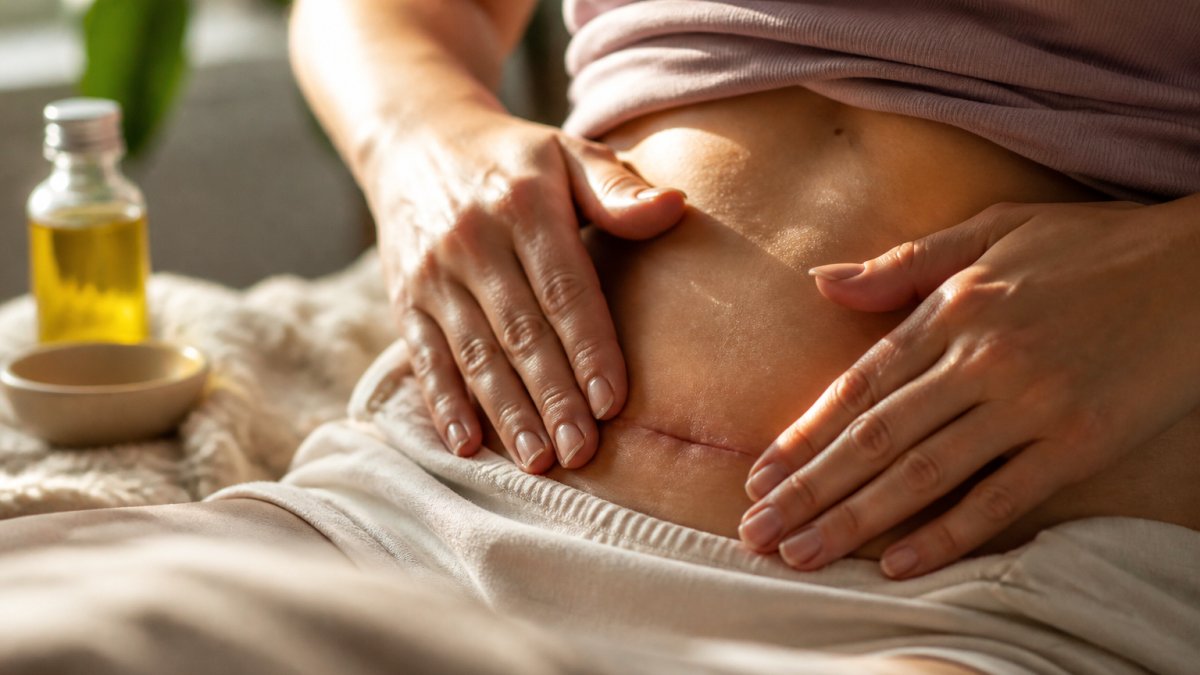
Here is a safe, staged plan to follow:
- Check first. Ask your midwife or doctor to confirm the wound has closed and there is no infection.
- Start with desensitization. Light fingertip strokes across the scar for 1 to 2 minutes, once a day.
- Add gentle mobilization. With clean hands and a little unscented oil, make small circles on and around the scar, staying comfortable.
- Work the surrounding tissue. Gently lift and roll the skin above and below the scar between finger and thumb.
- Build slowly. Two to three minutes, once or twice a day, is plenty at first.
Stop if you feel sharp pain. A mild stretch is fine; a sharp pull is not.
Manual therapy from a trained physiotherapist can help with stubborn adhesions, but the evidence for massage is modest. Think of it as one helpful tool, not a cure.
Soulager la douleur au quotidien : mouvements et adaptations
Everyday movement is where most of the practical relief happens. Small changes to how you sit, stand, lift and sleep take pressure off the scar and reduce pain. The goal is not to avoid movement but to move in ways that protect the scar while it heals.
Here is a practical, how-to breakdown for the first weeks and beyond.
Getting out of bed
Do not sit straight up. Roll onto your side, bring your knees toward your chest, and push up with your top arm while swinging your legs over the edge. This keeps your abdominal muscles from pulling on the incision. Keep a pillow nearby to hug against the scar if you need to cough or laugh while moving.
Coughing, laughing and sneezing
Hold a small pillow or folded towel firmly against the scar before you cough, laugh or sneeze. This supports the wound and reduces the pulling sensation. If coughing is frequent, tell your midwife or doctor, it may be worth checking for a respiratory issue.
Lifting and carrying
Avoid lifting anything heavier than your baby in the first 6 weeks. When you do lift your baby, bend at the knees, keep the baby close to your chest, and exhale as you stand. Do not twist while lifting. If you have older children, sit down to cuddle them rather than picking them up from standing.
Sitting and standing
Support your feet on a low stool when sitting so your abdomen stays relaxed. Avoid sitting for long stretches without moving, stand up and walk briefly every 30 to 60 minutes. When standing, keep your shoulders relaxed and avoid arching your back, which can pull on the scar.
Sleep positions
Sleep on your side with a pillow between your knees to keep your hips aligned and reduce strain on the abdomen. Some women find a pillow under the bump or along the scar helpful. Avoid sleeping flat on your stomach until the scar feels comfortable.
Clothing choices
Wear loose, soft clothing that sits above or well below the scar. High-waisted, seam-free underwear and trousers are often more comfortable than low-rise styles that rub the incision. Avoid tight waistbands, belts, and rough fabrics for the first few weeks.
Returning to exercise
Start with short walks, 5 to 10 minutes, and build gradually. Wait until your midwife or doctor confirms the wound is healing well before adding gentle core or pelvic floor work. Avoid high-impact activity, heavy lifting, and intense abdominal exercises for at least 6 to 8 weeks, and longer if you feel pulling or pain. A pelvic health physiotherapist can guide you on safe progression.
Pain relief options
Paracetamol is commonly used for post-surgical pain. Ibuprofen is often used as well, but if you are breastfeeding, check every medication with your doctor or pharmacist before taking it. Do not assume a drug is safe because it is sold without prescription. Follow the dosage instructions on the packet and do not exceed the recommended daily amount.
Warning signs of caesarean wound infection : reconnaître les signaux d'alerte
Warning signs of caesarean wound infection include spreading redness, increasing swelling, warmth around the scar, pus or discharge, a bad smell, fever, and pain that gets worse instead of better. But not all symptoms carry the same urgency. Here is how to tell the difference between something to mention at your next check and something that needs same-day or urgent attention.
Symptoms that need routine clinical advice
Contact your midwife or GP within a day or two if you notice:
- Redness that is spreading beyond the scar edges
- Thick, yellow or green discharge, or any unpleasant smell
- A low-grade fever (around 38°C) or feeling generally unwell
- The wound opening or separating at the edges
- Pain that is gradually worsening rather than improving
These signs do not always mean infection, but they should be assessed. In France, your midwife or GP is your first point of contact; the French national health insurance portal explains postpartum follow-up and who to call.
Symptoms that need urgent assessment
Seek urgent care the same day, or call emergency services if symptoms are severe, if you have:
- A high fever (above 38.5°C) with a hot, painful, swollen scar
- Severe or worsening abdominal pain
- Heavy bleeding that soaks a pad in an hour
- Chest pain, breathing difficulty, or a hot, swollen, painful leg
- Fainting, confusion, or feeling severely unwell
These can signal serious complications such as sepsis or deep vein thrombosis and should never wait. Do not monitor a fever with a painful, hot scar at home overnight, call your midwife or doctor promptly.
What to expect when you call
Your midwife or doctor will likely ask about the timing of symptoms, your temperature, and any discharge. They may examine the wound and, if infection is suspected, prescribe antibiotics or arrange a follow-up. Keep a simple note of your symptoms and temperature readings to share.
The NHS guide to caesarean section recovery lists these warning signs clearly, but always follow the advice of your own clinician in France.
Douleur persistante : que faire si la cicatrice fait encore mal après des mois
Pain that persists months or years after birth deserves attention. It is not simply something to live with.
Possible causes include adhesions that restrict soft tissue movement, nerve sensitivity around the scar, or, less often, conditions such as endometriosis in the scar. A healthcare professional can assess which is likely.
What to do:
- Describe the pain: sharp, burning, pulling, or numb.
- Note when it appears: exercise, periods, intercourse, or certain positions.
- Ask for a referral to a pelvic health physiotherapist or a specialist if pain continues.
Treatment options range from targeted manual therapy and desensitization to medical review. There is no single fix, and a proper assessment matters more than any one technique.
Conclusion
Scar pain after a caesarean is common, and it is treatable. The challenge is knowing which stage you are in and what your scar needs right now, from rest and wound care to gentle massage and staged movement.
Frequently Asked Questions
Combien de temps durent les douleurs de cicatrice de césarienne ?
La plupart des femmes ressentent une gêne ou une sensibilité pendant quelques semaines à quelques mois après la césarienne. La cicatrice continue de se remodeler pendant plusieurs mois, voire jusqu'à un an. Des tiraillements ou une sensibilité peuvent persister plus longtemps, surtout au niveau des tissus profonds. Si la douleur s'intensifie, s'accompagne de fièvre ou de rougeur, consultez rapidement un professionnel de santé.
Quand commencer le massage de la cicatrice de césarienne ?
Attendez que la plaie soit complètement fermée et que votre médecin ou sage-femme donne son feu vert, généralement après quelques semaines. Commencez par des effleurements très doux sur la cicatrice et autour, sans forcer. Si vous ressentez une douleur vive, arrêtez et demandez conseil. Un massage régulier et progressif peut aider à assouplir les tissus et réduire les adhérences.
Quels sont les signes d'infection d'une cicatrice de césarienne ?
Surveillez l'apparition de rougeur croissante, de gonflement, de chaleur locale, d'écoulement de pus ou de liquide malodorant, ainsi qu'une fièvre. Une douleur qui augmente au lieu de diminuer est aussi un signal d'alerte. En cas de doute, contactez sans attendre votre médecin ou votre sage-femme, car une infection nécessite un traitement adapté.
Peut-on utiliser une crème cicatrisante pendant l'allaitement ?
Certaines crèmes sont compatibles avec l'allaitement, mais demandez toujours l'avis de votre pharmacien ou de votre médecin avant d'en appliquer sur la cicatrice. Évitez les produits contenant des substances actives non recommandées pendant cette période. Une hydratation douce avec des produits simples et adaptés suffit souvent à limiter la sécheresse et les tiraillements.


